
For hospitality businesses trying to reduce their greenhouse gas emissions, one challenge can seem to overshadow all others: guests.
Whether it's travelling by plane, whacking up the heating to 24 degrees or creating food waste at a restaurant, how guests behave can be responsible for a sizeable (sometimes the biggest) portion of an organisation's greenhouse gas footprint.
To understand this issue in more depth, Climate Springboard supported University of Edinburgh MSc researcher Michael Gurney with his dissertation project this summer. His project asked: What drives guest behaviour at hospitality establishments? What kind of interventions to encourage more sustainable behaviour have worked, and why?
Michael interviewed hospitality managers across Scotland and surveyed guests at several establishments to try to answer these questions. Here is what his research found.
Which factors influence guest behaviour?
A person's nationality or cultural context can have a big influence. Guests from Europe, for example, were more likely to recycle, possibly due the European Union’s comprehensive recycling laws and expectations.
A guest's priorities during their stay are another big factor: when given a list to pick from, guests ranked 'engaging in responsible, sustainable practices' as their lowest priority by a wide margin. Yet in the same questionnaire people mostly said they thought that acting sustainably at a hotel or guest house was "worth it" even if it took effort, suggesting that while guests may want to behave sustainably, ultimately relaxation and luxury tend to take priority.
How much guests care for the environment was identified as another, closely linked, driver of behaviour. Interestingly, managers were divided in their views of guests' ecological mindset: visitors to cities were generally perceived as caring less, while visitors to rural and countryside spots (more hikers and nature-enthusiasts) were perceived as caring more.
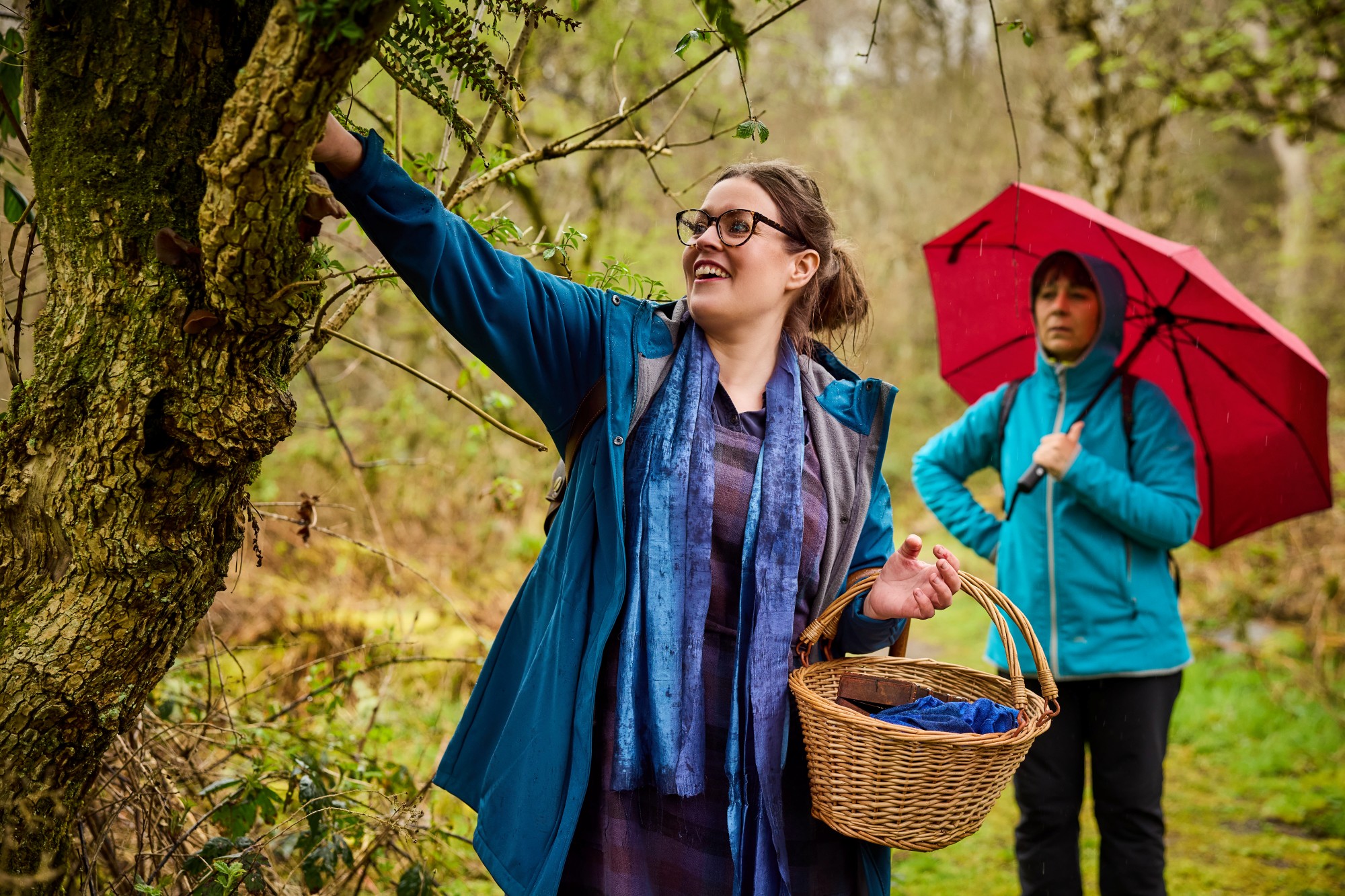

Hosting foraging walks, like this one in Cashel Forest, east of Loch Lomond, can help to create a nature- and climate-aware culture at your organisation that rubs off on guests. Image: VisitScotland
This suggests that there is an element of 'self-selection' by guests when it comes to choosing where to say. In other words, establishments that clearly market themselves as having environmental values will attract like-minded guests.
Nevertheless, the research also found that a guest's behaviour at home is often very entrenched, meaning they bring those habits - good or bad - with them on holiday.
What can you actually do about this?
Start with your own footprint. Hospitality managers agreed that the most reliable approach is simply to reduce the impact of guest behaviour by making their business' operations less polluting.
Installing rooftop solar panels or an air-source heat pump, for example, quickly reduces the emissions from guest electricity or heating use, without the need to change their behaviour at all. In short, anything you can do to make low-carbon the only choice: stop providing single-use items, fit low-flow water fixtures, set central heating to a fixed timer.
A step down from this are nudges. This involves making your desired behaviour easier than others, typically by making the sustainable option the default, without limiting choice entirely.
Offering mostly plant-based meals on a menu (and/or making those meals more prominent) and making room servicing opt-in rather than opt-out are examples of this.
Properly communicating these nudges is vital to their success, Michael observed. He writes: “Guests should be made aware of the options available to them, and what the establishment’s default practices are.”

Offering mostly plant-based meals are a way to 'nudge' guests toward lower-carbon diets. Image: VisitScotland
Another intervention highlighted in the research is behavioural appeals. This means directly asking guests to change their behaviour, such as requests to take public transport (instead of driving a private car or flying) or to keep the thermostat temperature low.
This approach can be tricky and gets mixed results, hospitality managers said. Guests at a luxury hotel, for example, would probably not act on requests to be frugal with hot water. The same request might be more effective directed to guests in a rural self-catered cottage, so it's important to pick the right intervention for your context.
Managers also reflected that, in their experience, providing awareness materials like pamphlets or webpages is generally not effective at changing guest behaviour.
Nonetheless, according to the visitor survey, a majority said they were unsure how to behave more sustainably during their stay, suggesting an opportunity to fill a knowledge gap. To this end, Michael suggests placing awareness materials in "high-traffic areas or at certain touchpoints designed for guest engagement."
Finally, there are certain actions which create a culture of sustainability that rubs off on your guests. This might include partnering with a local nature guide to host foraging walks, starting a food forest or promoting your staff's monthly beach clean.
It's not always easy to make a direct link between these interventions and guest behaviour; they are more likely to result in diffuse, long-term change than immediate returns.
Greener guests?
While there are no silver bullets, this research underscores the important point that hospitality establishments can influence how guests behave, as many managers acknowledged.
If you'd like our help to get started (or to read a more detailed summary of Michael Gurney's dissertation), reach out to us at climatespringboard@ed.ac.uk.
Or register for our free Climate Action Accelerator for tourism and events SMEs, delivered in live, online workshops over six weeks on behalf of VisitScotland. The next cohort starts in October, followed by a cohort each month from November to February.