
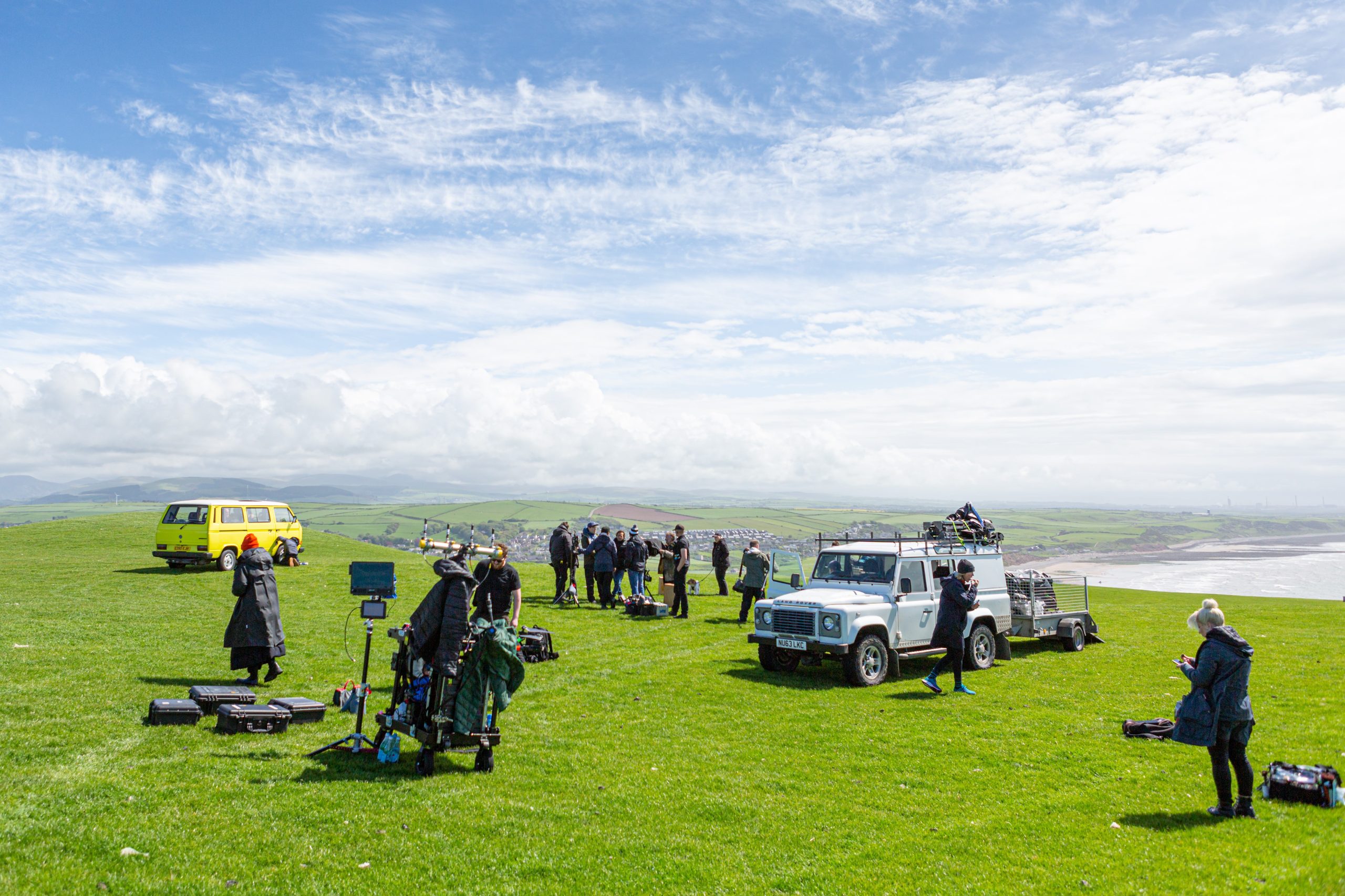
How do you begin to write a sustainable travel policy for a company whose job relies on travel? That was the task facing Laura Coulthart in early 2023, when she joined the Edinburgh Net Zero* training cohort.
Laura is the People and Operations manager at LS Productions, the country’s largest production services company. Known for their BAFTA- and Brit Award-winning work, LS work with some of the world's biggest brands and A-List talent: producing commercials, fashion shoots, music videos and film and tv projects internationally and at home in the UK.
In practice, this involves planning complex logistics, travelling between offices in Edinburgh, Manchester and London, scouting shoot locations and fulfilling clients briefs that can take them across the globe to find the perfect location.
Laura’s sustainability journey started with cutting office plastic waste when she joined LS Productions seven years ago as an office assistant. Now, she leads the implementation of the company’s first-ever sustainable travel policy across an international team of 40.
Business travel – one of the firm's largest sources of CO2 – was the logical first step, says Laura. “It was relatively easy to get the data and is a tangible thing that people can understand the impact of”.
So what’s in the policy? The company decided not to place a blanket ban on high-emission modes of transport like flying, but instead formalised many of the unspoken rules that staff were already following. The policy makes visible their commitment to reducing their environmental impact – and has been a hit with clients.
“Trains first”
Laura started by identifying the most frequently travelled routes to tackle emissions from business travel. LS Productions' staff often travel between Edinburgh and London, so have made taking the train the default option.
Staff are supported to work on the train, with many people reporting that they prefer this way to travel. The option for staff to book onto sleeper trains is encouraged if it works for them and their filming or meeting commitments at the other end too. London-based staff also take advantage of the connections to European rail networks, prioritising train travel for direct routes, such as to Paris and Berlin for events.
Staff also use Seat Frog, an app that allows you to bid for cheap first-class seats on the UK rail network. This has proven a great incentive for taking the train, especially on longer journeys.
Plane and simple
When taking a flight is required, due to time or cost, LS Productions aim where possible to:
Cars
LS Productions rely on hire vehicles to move their team and equipment around. Their suppliers of hire vans in the UK, Arnold Clark and Enterprise, provide monthly mileage and CO2 emissions data for journeys made in petrol and diesel cars. This helps them build a clearer picture of their climate footprint – and find other ways to reduce it.
For example, hire vans and cars are the only practical option for getting to remote shooting locations such as the Scottish Highlands. So, it’s the job of their location scouts to flag this and, depending on the location, arrange car sharing to keep the number of vehicles to a minimum.
For high-profile clients, LS Productions works with eco-concierge company, EcoLux Cars, who provide high-end electric cars.
Doing things differently
To limit and avoid unnecessary international travel, LS Productions have established a network of vetted partner production companies around the world.
For shoots that need to happen overseas, instead of flying large teams and heavy equipment long distances, one or two from the LS team will fly out to oversee the production, which is delivered by one of their partners. This means they can work with clients who don’t want to be limited to UK locations, benefit from each partner’s local expertise, and keep their air miles (and emissions) to a minimum.
Are there ways you could be doing things differently in your own company to reduce business travel, innovate and save money?